Architectural Guide to Greystones and Bungalows in Lincoln Square
May 28, 2026
May 28, 2026
If you have ever walked through Lincoln Square and wondered why one block feels full of cozy brick homes while the next shows off tall limestone-front buildings, you are not imagining it. This part of Chicago has a layered residential history, and that mix can make buying, renovating, or selling here feel both exciting and a little complex. In this guide, you’ll learn how to spot the key differences between greystones and bungalows in Lincoln Square, what floor plans and updates buyers often expect, and which maintenance details matter most. Let’s dive in.
Lincoln Square is Community Area 4 on Chicago’s North Side, and its built environment reflects more than one era of growth. Local history sources describe the area as changing from farm and prairie land into a fast-growing residential district in the early 1900s, especially after electric streetcars and the elevated line opened in 1907.
That history helps explain why Lincoln Square is not a one-style neighborhood. Public cultural history sources describe architecture here as ranging from Victorian-era buildings to newer infill, while the area also sits within Chicago’s well-known bungalow belt.
By the time of the Great Depression, Chicago had roughly 80,000 bungalows across a wide arc of the city that included Lincoln Square. Today, that legacy still shows up in the streetscape, where bungalows, greystones, and brick two-flats can appear on nearby blocks or even side by side.
For you as a buyer or owner, that means homes in Lincoln Square are often compared by charm, condition, and expansion potential rather than by style alone. The neighborhood’s appeal comes partly from that architectural variety.
A Chicago bungalow is usually a brick home with about one-and-a-half stories above a basement. It typically has a low-pitched hipped roof, a front porch, generous windows, and a simple rectangular footprint.
The style dates mainly from the 1910s through the mid-1930s and reflects Arts and Crafts influence adapted for Chicago’s narrow lots and weather. In Lincoln Square, that makes the bungalow feel practical, familiar, and closely tied to the neighborhood’s early 20th-century growth.
Inside, bungalow floor plans often follow a recognizable pattern. You’ll usually find a front living room, a dining room, and a kitchen, with bedrooms placed to create more privacy from the main gathering spaces.
One reason buyers still respond to bungalows is flexibility. Attics and basements were often designed with future finishing in mind, so these homes can offer room to expand over time without changing their core layout.
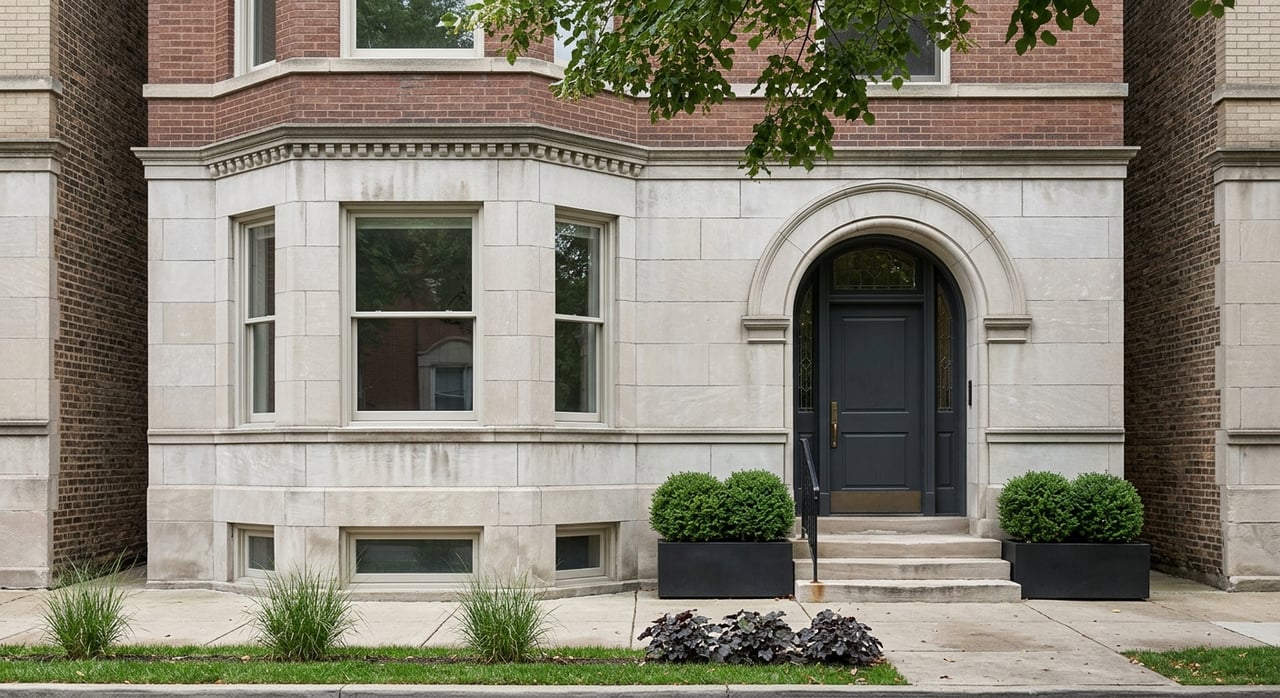
In Chicago, a greystone usually means a building with a limestone front and brick side walls. These homes are often two or three stories tall and tend to present a more vertical, formal street presence than a bungalow.
Greystones in Chicago were built broadly from about 1890 to 1940. While their basic shape can be straightforward, the detailing is often more decorative and visually rich.
You may notice arched windows, columns, pediments, parapets, and carved stonework. Even when the layout is simple, the façade often gives the home a strong architectural identity.
In Lincoln Square, greystones can stand out for their scale and ornament. Buyers often notice not just the exterior character, but also how these homes pair vintage detail with flexible future use.
Bungalows and greystones can both offer vintage appeal, but they usually live differently. Understanding those patterns can help you judge whether a home fits your needs now and your plans later.
A typical bungalow leans into a defined room sequence. In recent Lincoln Square listings, that often shows up as a living room up front, a dining room behind it, and a kitchen toward the rear, with attic and basement space that may be unfinished, partially finished, or ready for future work.
That setup tends to appeal to buyers who want a single-family feel with room to grow. Recent examples in Lincoln Square have highlighted updates like new plumbing, new roofs, new windows, reworked kitchens, and basements with space for added family rooms or extra bedrooms.
Greystones often appeal for different reasons. Recent Lincoln Square examples have called out bay windows, stained woodwork, arched doorways, built-ins, and high ceilings, along with possibilities for conversion or alternate layouts.
That distinction matters when you compare homes. A bungalow often wins buyers over with practical expansion space, while a greystone may stand out through scale, original detailing, and how it can adapt over time.
Even though this guide focuses on greystones and bungalows, Lincoln Square includes other pre-war housing types that shape the neighborhood’s character. You may also come across workers cottages, American Foursquares, Prairie-style homes, and brick two- and three-flats.
These forms matter because they add context when you are comparing properties. A brick two-flat, for example, may be discussed less for its architectural label and more for unit count, finished lower-level space, or layout flexibility.
That mix is part of what makes Lincoln Square feel architecturally layered instead of uniform. If you are buying or selling here, it helps to understand not just style names, but how each building type tends to function in real life.
Many older homes in Lincoln Square have already been updated in some way, while others still offer room for major improvements. That is especially true for bungalows, where attic buildouts and rear additions are common renovation paths.
The Chicago Bungalow Association recommends keeping added attic volume set back from the front façade and using materials that are compatible with the original house. It also points to two common approaches: a modest attic buildout that improves function without heavily changing the roofline, or a rear addition that expands kitchen and family space.
For landmarked properties, Chicago’s rehabilitation standards add another layer. New work should not destroy historic materials and should stay compatible with the building’s massing, size, scale, and architectural features.
If you are evaluating a home with renovation potential, this is where local due diligence matters. A design idea that works well on one block may need a different approach on another depending on the property’s status and existing architecture.
With older Lincoln Square homes, exterior work deserves careful attention. Preservation guidance from the Chicago Bungalow Association recommends repairing historic wood windows when possible rather than replacing them automatically.
If replacement becomes necessary, the new windows should closely match the historic design. Chicago’s rehabilitation standards take a similar approach and say replacement windows should match historic design, operation, material, glass size, muntins, and trim.
Masonry care matters too, especially for greystones and brick homes. Chicago’s standards say masonry buildings should not be painted, and sandblasting is considered inappropriate.
For owners, the big takeaway is simple: original exterior materials often add both character and long-term value, but they need informed maintenance. Quick cosmetic changes may not be the best long-term choice for a vintage home.
Older homes are not just about style. Their performance depends on systems you may not see at first glance.
The Chicago Bungalow Association notes that steam heat systems can be efficient when they are properly maintained. It recommends a fall inspection and flags common issues in older homes such as corrosion, low pressure, slow drains, and frozen pipes in unconditioned spaces.
Water management is just as important. Regular roof and gutter maintenance, clean downspouts, and attention to ice dams can help prevent avoidable damage.
If you are buying or preparing to sell a bungalow or greystone, these basics can shape both daily comfort and future repair costs. In many older homes, routine maintenance has a direct effect on value and buyer confidence.
In Lincoln Square, architecture is more than curb appeal. It shapes how a home lives, what updates may be possible, and how buyers interpret value.
If you are buying, understanding the difference between a bungalow and a greystone can help you look past surface finishes and focus on layout, condition, and realistic renovation potential. That can lead to stronger decisions when you compare homes that may look equally appealing from the sidewalk.
If you are selling, knowing how your home fits into the neighborhood’s architectural story can help position it more clearly. Features like original woodwork, limestone detailing, attic expansion potential, or a finished basement often matter most when they are framed in the right local context.
That is where neighborhood-specific guidance makes a difference. In a place like Lincoln Square, buyers are rarely judging a home in isolation. They are comparing it against a rich mix of vintage housing types across the same market.
If you are thinking about buying or selling a vintage home on Chicago’s North Side, working with a team that understands architecture, block-by-block housing patterns, and how buyers evaluate condition can make the process much clearer. You can start the conversation with Leigh Marcus.

2203 W Roscoe St Chicago, IL 60618 30 Green Bay Road Winnetka, IL 60093