North Center Living: Parks, Breweries, and Everyday Routines
June 25, 2026
June 25, 2026
Looking for a Chicago neighborhood where your daily routine can feel both easy and interesting? North Center stands out for exactly that reason. If you want a place where a Saturday market, a river walk, a neighborhood park, and a brewery patio can all fit into one weekend, this guide will help you picture what life here can look like. Let’s dive in.
North Center is a North Side Chicago community about seven miles northwest of the Loop. The North Center Neighbors Association describes it as generally bounded by Montrose to the north, Addison to the south, the Chicago River to the west, and Ravenswood to the east, though some sources place the southern edge at Diversey.
What makes the area memorable is not just one attraction. It is the way daily life comes together through local parks, neighborhood gathering spots, and a steady calendar of casual things to do. Choose Chicago highlights North Center for old-school Chicago character, local hangouts, live music, breweries, and theater.
If you are comparing North Center with other North Side neighborhoods, the park access is one of the first things to notice. The neighborhood has a park-dense feel that shows up in everyday routines, not just on a map.
The North Center Neighbors Association lists North Center Town Square, Revere Park, Welles Park, Fellger Park, and Horner Park as key local gathering spots. That gives you several ways to build a routine around outdoor time, whether you want a quick stop with coffee, an afternoon playground visit, or a longer walk.
One of the clearest lifestyle features in North Center is 312 RiverRun. According to the Metropolitan Water Reclamation District, it is an off-street multi-use trail along the North Branch of the Chicago River that links three parks for nearly two miles from Montrose to Belmont.
That connection matters because it ties together movement and recreation in a way that feels practical. The trail includes a link between California Park and Horner Park, which helps create an easy route for walking, biking, or simply getting outside without needing a big plan.
Horner Park brings a different kind of outdoor experience. The Horner Park Natural Area includes about 11 acres of savanna, prairie, and riparian habitat, along with roughly 1.3 miles of mulch trails along the river.
If you like a more natural setting within the city, this is one of the area's standout features. It adds a quieter counterpoint to the more active and social parts of the neighborhood.
Revere Park shows the active-recreation side of North Center. The Chicago Park District says the 9.49-acre park on Irving Park Road offers year-round athletic programming, four tennis courts, and an ADA-accessible playground.
The park has also seen updates in 2025, including four resurfaced tennis courts and two pickleball courts. For buyers thinking about how often they will actually use neighborhood amenities, details like that can matter more than a long list of one-time attractions.
North Center also has a strong local hangout culture. This is a neighborhood where breweries are part of the routine, not just occasional destinations.
Burning Bush describes itself as a family-owned microbrewery in the heart of North Center, with 12 rotating taps, a river patio, weekly trivia and game nights, monthly beer releases, live music, and a first-Friday live music series. That kind of programming helps explain why the neighborhood often feels active without feeling hectic.
Dovetail also has a visible place in the area’s brewery identity. It places its taproom in the Ravenswood Corridor and North Center neighborhood, just north of Irving Park Road. Choose Chicago also points to Dovetail and Begyle as part of the neighborhood’s craft brewery scene.
North Center’s social rhythm goes beyond breweries. The Northcenter Farmers Market runs on Saturdays from 8:00 a.m. to 1:00 p.m. from June 13 through October 31 at Northcenter Town Square, and the Chamber describes it as one of the oldest markets on the North Side.
The market includes produce, flowers, pastries, and other handmade goods. For many people, that kind of recurring event says more about neighborhood lifestyle than a one-time festival because it gives structure to the week.
The Chamber’s event calendar adds even more seasonal rhythm. It includes a Summer Concert Series, Hop 'N' Stop, Ribfest Chicago, and North Side Restaurant Week. The Chamber says Ribfest has been hosted for more than 20 years and draws about 50,000 guests annually.
If you are trying to picture everyday life here, the routine is fairly easy to imagine. A North Center weekend can start at the farmers market, move to a park or river walk, and end with a brewery patio or live music.
That is part of the neighborhood’s appeal. You do not have to choose between a residential feel and things to do. North Center offers both in a way that feels connected and usable.
The housing mix in North Center supports the neighborhood’s balanced feel. CMAP reports that 27.0% of the housing stock is detached single-family homes, 25.4% is in three- or four-unit buildings, 17.4% is in two-unit buildings, and 8.9% is in buildings with 20 or more units.
More than half of the housing stock was built before 1940, and 56.9% of occupied units are owner-occupied. In practical terms, that points to a neighborhood with a strong prewar housing presence and a mix of home types that can appeal to buyers looking for single-family homes, condos, or smaller multifamily buildings.
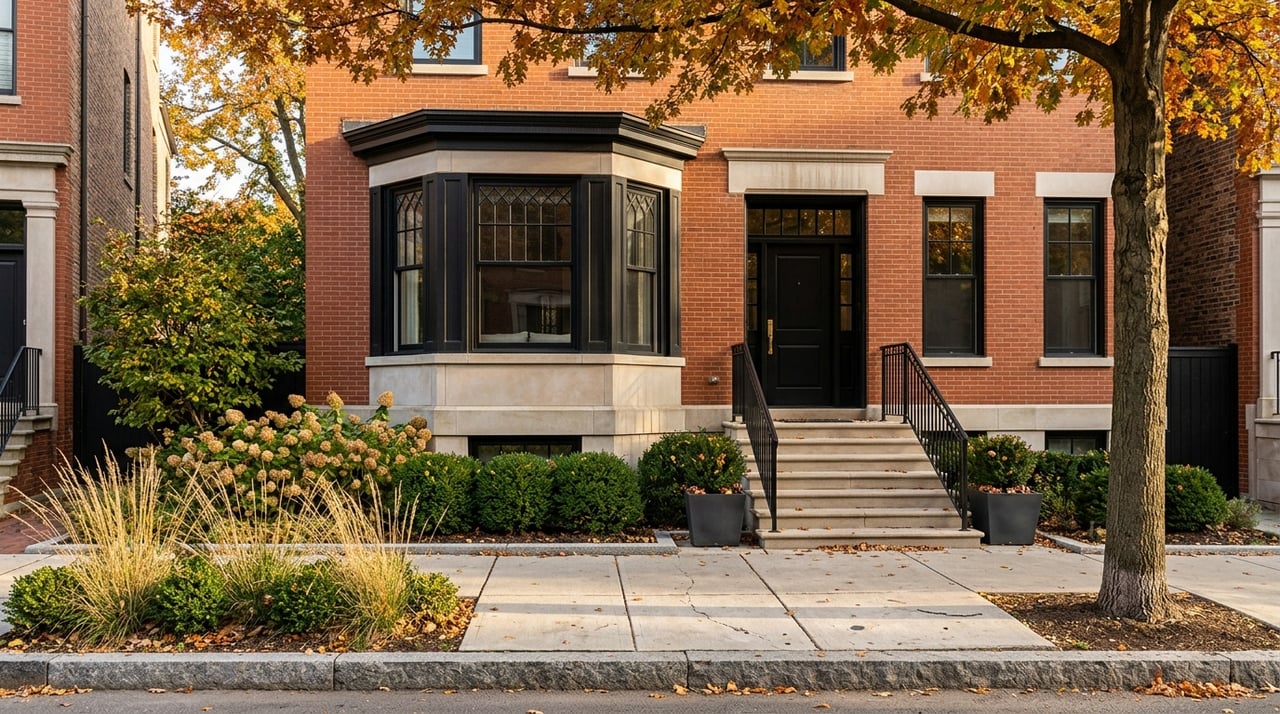
For many buyers, North Center does not read like a high-rise district. The data suggests a more residential, prewar-heavy neighborhood with detached homes, two-flats, and smaller multifamily buildings playing a major role in the streetscape.
That housing character often pairs well with the lifestyle side of the neighborhood. You get city access and neighborhood activity, but the built environment can feel more grounded and established.
Transportation is another part of what makes North Center workable day to day. CMAP reports that 38.3% of workers in North Center work from home, 15.1% commute by transit, and 6.0% walk or bike.
Those numbers suggest a mix of routines rather than a one-size-fits-all pattern. Some households are fully car-dependent, some are car-light, and some work mostly from home and use transit, walking, or biking more selectively.
The Chamber adds that Northcenter is served by several bus lines and Brown Line stops at Addison, Irving Park, and Montrose. Divvy and street parking are also part of the transportation picture.
For some households, yes. CMAP says 12.0% of households in North Center have no vehicle available, while 52.5% have one vehicle.
That does not mean every block or routine will feel the same, but it does support the idea that many residents can build a workable lifestyle around transit, biking, walking, and nearby amenities. If you want a neighborhood that offers flexibility instead of requiring one specific way to move around, North Center checks that box.
North Center can be especially appealing if you want a neighborhood that feels active but not overwhelming. The combination of parks, river access, breweries, live events, and mixed housing stock gives it a day-to-day usability that stands out.
For buyers, that often translates into a simple question: can you see yourself actually living your week here, not just visiting it? In North Center, the answer is often yes because the routines feel easy to picture.
If you are exploring North Side neighborhoods, it helps to compare not just homes but how each area supports the life you want to build. North Center offers a clear mix of residential character, local activity, and practical access that continues to draw attention from buyers across Chicago’s North Side.
If you want help evaluating North Center homes, condos, or multifamily opportunities with a neighborhood-first and data-driven approach, connect with Leigh Marcus.

2203 W Roscoe St Chicago, IL 60618 30 Green Bay Road Winnetka, IL 60093