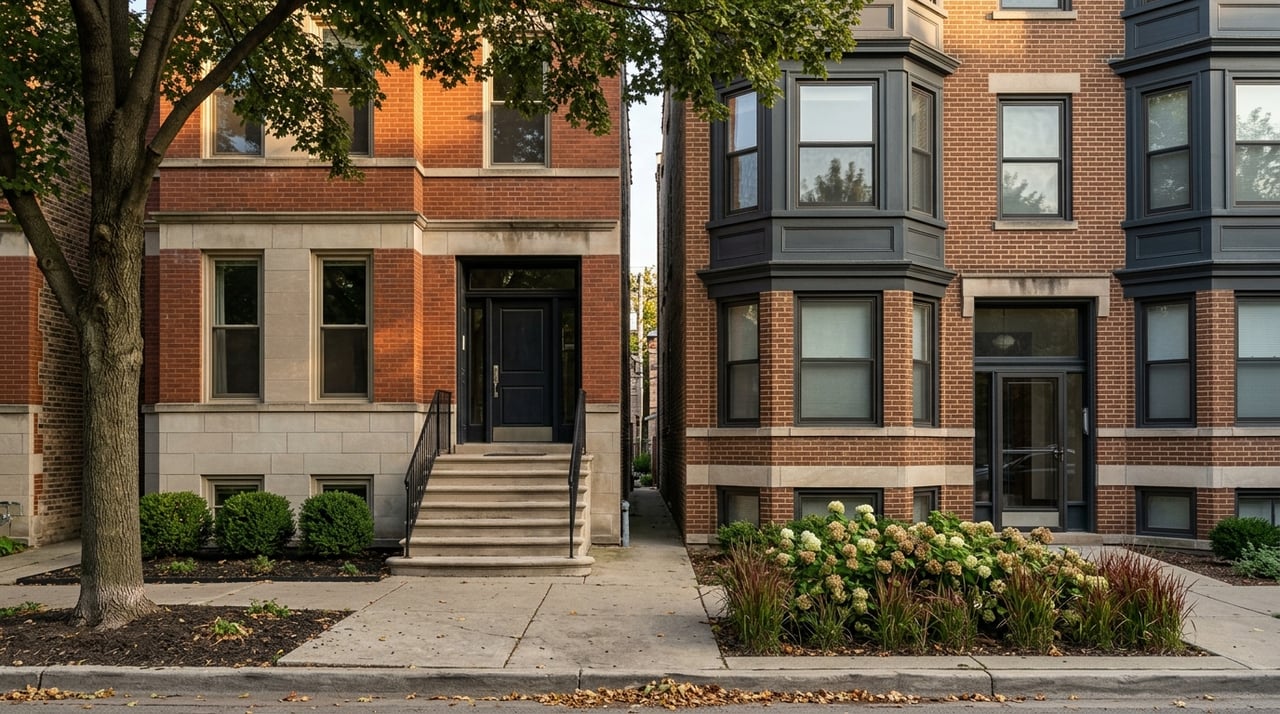
Single-Family or Three-Flat? How Lincoln Square Buyers Decide
June 4, 2026
June 4, 2026
Trying to choose between a single-family home and a three-flat in Lincoln Square? You are not alone. In this part of Chicago, that decision comes up often because the neighborhood offers a real mix of home types, and each one supports a very different kind of ownership experience. If you are weighing privacy, rental income, flexibility, and long-term resale, this guide will help you think through the tradeoffs with Lincoln Square’s housing stock and market realities in mind. Let’s dive in.
Lincoln Square is not a neighborhood where one housing type dominates everything else. According to CMAP’s 2019-2023 snapshot, detached single-family homes make up 14.8% of housing units, while 2-unit buildings account for 13.6% and 3- or 4-unit buildings make up 20.7%. Together, 2- to 4-unit properties represent 34.3% of the housing stock.
That matters because your decision is not just about personal taste. It is also about buying into a neighborhood where small multifamily buildings are a major part of the local housing landscape. Enterprise Community Partners reinforces that point, reporting 6,470 units in 5-to-49-unit properties, equal to 32.8% of all residential units in the community area.
Lincoln Square also has more renters than owners. CMAP shows renter-occupied households at 59.1% and owner-occupied households at 40.9%. In practical terms, that helps explain why many buyers here seriously consider whether a two-flat or three-flat could offer useful rental potential.
If your top priorities are privacy, quieter day-to-day living, and a more traditional ownership setup, a single-family home often feels like the cleaner fit. You are typically not sharing walls or common spaces with tenants, and you are not stepping into a landlord role from day one.
That simplicity can be a real advantage. You can focus on your own household, your own maintenance plan, and your own long-term use of the property without adding tenant turnover, lease logistics, or rental accounting to the mix. For many buyers, that lower operational complexity is worth a lot.
A single-family home may also align better if you want a straightforward resale story later. In Lincoln Square, a well-maintained single-family property often appeals to end users who value privacy and a simpler ownership experience. That resale angle is a practical inference from the neighborhood’s housing mix and buyer demand profile.
If you want your home to do more than just house you, a three-flat may be worth a closer look. In Lincoln Square, where multifamily housing is a meaningful part of the market and renter occupancy is high, a three-flat can offer flexibility that a single-family home usually cannot.
That flexibility can show up in a few ways. You may use one unit as your primary residence and rent the others. You may also like the option of multigenerational living down the road, with separate spaces that can work for relatives while keeping some independence for everyone.
The financial appeal is also easy to understand. For buyers who want rent to help carry the mortgage, a 2- to 4-unit principal residence can be materially different from a single-family home. Fannie Mae states that rental income from a 2- to 4-unit principal residence can be used in qualifying under applicable documentation rules, and gross monthly rent must still be documented even if you are not using it to qualify.
A three-flat can create opportunity, but it also changes the nature of ownership. Instead of simply owning your home, you may also be managing leases, maintenance requests, turnover, and the general rhythm of being a landlord.
That does not make it a bad choice. It just means you should evaluate it honestly. The right comparison is not only purchase price versus purchase price, but also monthly carrying cost, time commitment, and your comfort with landlord responsibilities.
Financing can be more involved too. Fannie Mae treats 2- to 4-unit principal residences differently from 1-unit homes, and rental-income documentation requirements add paperwork and complexity to the process. If you are considering a three-flat, it helps to go in expecting a more layered financing conversation.
No matter which path you choose, age of housing stock is a major part of the Lincoln Square story. CMAP reports a median year built of 1942, and 48.4% of housing units were built before 1940.
That age can be part of the neighborhood’s appeal, but it also raises the stakes on due diligence. Buyers should expect to take a closer look at roofs, masonry, plumbing, electrical systems, and heating. The maintenance implications are a practical inference from the age of the local housing stock.
For a single-family home, that may mean planning for larger capital projects over time. For a three-flat, it can mean those same issues affect multiple units and multiple residents, which may increase both cost and management demands. In either case, strong inspections and realistic reserves matter.
Taxes are another area where single-family and three-flat ownership can diverge. Illinois offers a property tax credit equal to 5% of Illinois property tax paid on a principal residence. According to the Illinois Department of Revenue, for a multi-unit property, that credit can include only the tax assessed on the unit that is your Illinois residence.
Cook County also offers a Homeowner Exemption for most owners who own and occupy the property as their principal residence. The exemption reduces equalized assessed value, automatically renews once applied, and the Cook County Treasurer says it has reduced equalized assessed value by $10,000 starting in Tax Year 2017.
If you are buying a three-flat, it is smart to confirm exactly how the parcel’s exemptions apply to your building type and occupancy plan. The details matter, especially when you are comparing total carrying costs between a single-family home and a multi-unit property.
Resale is not identical for these two property types. A single-family home usually speaks to buyers who want privacy and simplicity. A three-flat can appeal to owner-occupants, buyers looking for rental income, and households that want more flexible use over time.
In Lincoln Square, that broader multifamily buyer pool is supported by the neighborhood’s local makeup. CMAP data shows a sizable concentration of 2- to 4-unit buildings and a majority renter population, which supports the idea that a well-positioned income property can have meaningful appeal.
That said, condition matters a lot. A three-flat’s resale story often depends on both rentability and building condition, while a single-family home may be judged more heavily on layout, updates, and overall livability. In both cases, maintenance quality is a major factor.
If you are stuck between the two, this simple framework can help clarify your direction.
Even if you know which property type fits you better, timing matters in Lincoln Square. Realtor.com’s April 2026 snapshot reported 75 homes for sale, a median listing price of $589,000, and a 25-day median on market.
That kind of pace suggests buyers should be prepared to move decisively when the right property appears. The better your decision framework is before you start touring, the easier it becomes to act with confidence when you find a match.
The most important question is not which option is better in the abstract. It is which option fits your finances, daily life, and long-term plans in Lincoln Square. If you want help weighing a single-family home against a three-flat with real neighborhood context, the team at Leigh Marcus can help you evaluate the numbers, the tradeoffs, and the fit.

2203 W Roscoe St Chicago, IL 60618 30 Green Bay Road Winnetka, IL 60093