Southport Avenue's Storefronts Keep Changing. So Are the Buildings Underneath Them
September 3, 2026
September 3, 2026
Colectivo Coffee finally opened its doors on July 8, at the corner of Southport and School Street, in the space that spent more than a year as a stalled construction site. The original plan was a straightforward conversion of the old Schoolyard Tavern into a café. Then crews found a structural problem with the building's south wall, the kind that turns a simple buildout into a full rebuild. Regulars who watched the scaffolding sit there for months on end finally got their reward: a roughly 40-seat café with patio seating, open daily from 6:30 a.m. to 6:30 p.m., the Milwaukee roaster's seventh Chicago-area location.
That's the kind of update that travels fast through every Lakeview group chat and neighborhood Facebook page. It's also, in the context of what's actually happening on Southport Avenue this year, the smaller story. A few blocks in either direction, whole buildings are coming down and going up, and the corridor's southern edge is being redrawn by a development that will eventually be bigger than the strip most residents think of as Southport.
If you've walked the corridor between Belmont and Irving Park this year, the churn has been hard to miss. STRONG Pilates, the Australian fitness brand, opened its first Chicago-area studio here on June 6. Reformation is moving into the space Dr. Martens vacated. HYOU Fine Jewelry is taking over 3530 N. Southport, in the storefront ThirdLove is leaving behind. Lovesac has signed a lease for the old Aligned Modern Health space at 3514 N. Southport. And this fall, a new concept blending indoor golf with a neighborhood club atmosphere is set to open on the strip, a leisure concept that's new to the corridor.
Line those changes up and a pattern shows up that's easy to miss one storefront at a time. The businesses leaving tend to be apparel and single-purpose retail. The businesses arriving tend to be daytime, wellness, and gathering spaces: a coffee shop where a tavern used to be, a Pilates studio, an indoor golf lounge. Colectivo backfilling a former tavern space fits a broader pattern on the strip, where cafes and casual gathering spots have increasingly been replacing traditional nightlife concepts. The Music Box Theatre made a parallel bet on gathering space this summer, debuting a long-awaited third screen at its Southport Avenue home, which first opened in 1929. The expansion gives the arthouse cinema room for more community events and Chicago filmmaker premieres, on top of its existing approach of treating every day like part of a film festival.
None of this is dramatic on its own. A coffee shop, a fitness studio, a jewelry store swap. What makes this year different is that it's happening at a pace and in a cluster that hasn't been typical for the corridor, and it's happening at the same time the buildings themselves are getting torn down and rebuilt.
| Address | What Left | What's Arriving | Status as of late August 2026 |
|---|---|---|---|
| 3258 N. Southport | Schoolyard Tavern | Colectivo Coffee | Open (since July 8) |
| Southport (Dr. Martens space) | Dr. Martens | Reformation | Opening |
| 3530 N. Southport | ThirdLove | HYOU Fine Jewelry | Confirmed, opening pending |
| 3514 N. Southport | Aligned Modern Health | Lovesac | Lease signed, opening pending |
| Southport (fitness space) | — | STRONG Pilates | Open (since June 6) |
| Southport (concept TBD) | — | Indoor golf and club concept | Opening this fall |
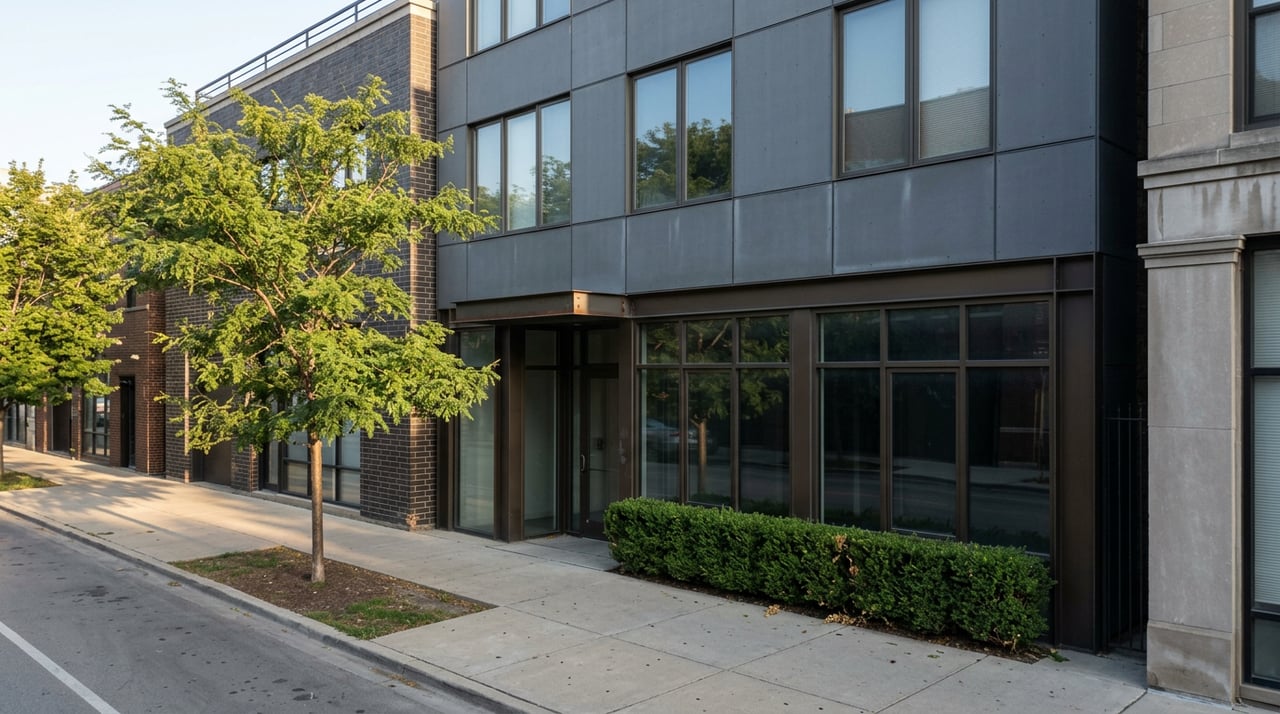
Walk past the retail swaps and you'll run into a second layer of change: demolition and construction, not just on Southport itself but on the streets around it. At 1215 W. Belmont, the former home of Stage 773 (the theater closed in 2021), demolition permits have cleared the way for a new mixed-use residential building right at the corridor's southern tip. A short walk east on Sheffield Avenue, at 3233 N. Sheffield, the City Council gave final approval to a 99-unit apartment development after the property sold for $6.25 million. Further east on Halsted Street, at 3611 N. Halsted, the city approved a 12-story, 188-unit building from DLG Development and Studio Dwell Architects, with 38 units set aside as affordable and a small ground-floor café. And back on Southport itself, at 3600 N. Southport, the corner that used to hold a Fifth Third Bank branch, the first renderings for a new mixed-use retail-and-apartment building have just been released.
Add up just the two projects with confirmed unit counts, Sheffield and Halsted, and that's 287 new apartments approved within a few blocks of the corridor, on top of whatever lands at 1215 W. Belmont and 3600 N. Southport once those projects finalize their plans. None of that shows up when you're standing in line at Colectivo. It shows up in the demolition fencing a few blocks over, and in the permit filings most residents never think to check.
The biggest piece of this puzzle sits just past where most people think Southport Avenue ends. In February, the Chicago City Council gave final approval to Foundry Park, a mixed-use development on the northern portion of the long-stalled Lincoln Yards site, along the Chicago River. The project comes from JDL Development and Kayne Anderson Real Estate, and it's designed to treat Southport Avenue itself as the development's central spine, extending the street south past Cortland into new territory.
The scale is not subtle. Foundry Park is planned to deliver more than 3,200 housing units across multiple phases, with the first phase alone calling for roughly 800 residential units and a hotel with around 180 rooms, spread across four buildings ranging from 8 to 38 stories, the tallest reaching about 520 feet. A two-level underground garage will hold roughly 800 parking spaces. Above ground, the plan sets aside close to 10 acres of parkland and a new riverwalk stretching about 3,000 feet, with a potential connection to an extension of the 606 Trail. Permitting for the first phase was expected to begin in late 2026, meaning the groundbreaking most residents have only seen in renderings could start showing up as visible construction before the year is out.
Southport Avenue, in other words, is not staying the six-block strip between Belmont and Irving Park that longtime residents know. It's being extended south into a development that will eventually dwarf the shopping strip it's stretching out from.
Put the three layers together and a clearer picture emerges than any single headline about a new coffee shop or a new development approval gives you. The storefronts on Southport are refreshing at a pace that favors daytime, wellness, and gathering-oriented businesses over the apparel and single-purpose retail that used to fill those spaces. The corner buildings within the corridor itself are being demolished and replaced with taller, denser residential buildings, adding hundreds of new neighbors within a few blocks of Belmont and Southport before any of the bigger projects break ground. And the street's southern edge is being extended into a $3 billion district that will eventually connect the corridor to the river and to the 606.
That's a different story than "Southport got a new coffee shop," even though the coffee shop is the version of the story most people will hear first. The Lakeview Taco Fest wrapped up its 13th year on Southport in late August, drawing the usual crowds for tacos and live music on two stages, a reminder that the corridor's day-to-day rhythm still looks the same as it always has. But the ground underneath that rhythm is shifting faster than the festival calendar suggests, and the changes coming this fall, an indoor golf concept opening on the strip, permitting starting on Foundry Park's first phase, are the next visible signs of it.
If you've lived on or near Southport for a while, none of this will surprise you completely. You've probably already noticed the fencing, the permit notices taped to storefront windows, the slow disappearance of a bank branch or a shoe store you used to walk past without thinking. What this adds up to is a corridor that's changing on two timelines at once: the fast one you can see from the sidewalk, and the slower one written into City Council votes and zoning applications that will reshape the block over the next several years.
If you're trying to make sense of what any of this means for your own address, whether it's a good time to sell, what a nearby development might do to your property's value, or how the corridor's changes stack up against what's happening in Lincoln Park or Roscoe Village, that's exactly the kind of question the Leigh Marcus Team spends its time answering for North Side homeowners. Book a consultation and we'll walk through what's actually happening on your block, not just what's in the headlines.

2203 W Roscoe St Chicago, IL 60618 30 Green Bay Road Winnetka, IL 60093