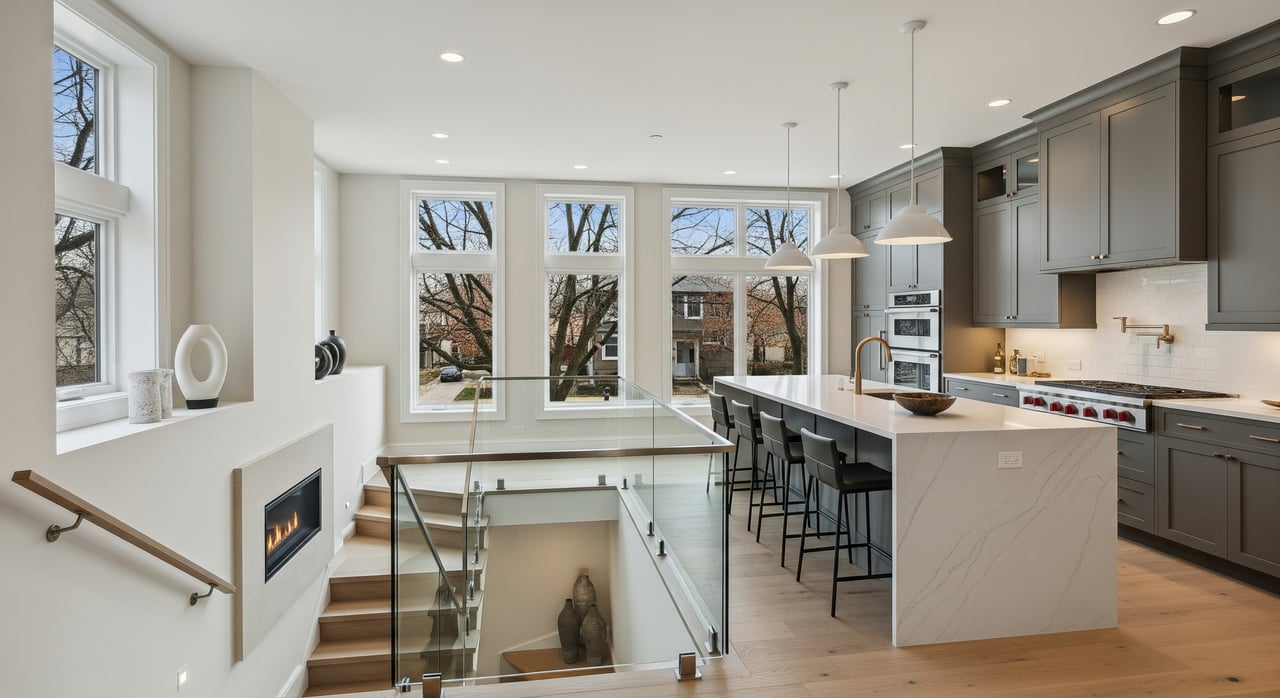
Seeing “duplex-down” on listings and not sure what it really means in Lakeview? If you live in Palatine or elsewhere in Cook County and are exploring a move to the city, this term comes up a lot in Chicago condo searches. You want the space and value, but you also want to avoid surprises with light, moisture, or HOA costs. In this guide, you’ll learn what a duplex-down is, how it lives day to day, the pros and cons, what to ask at showings, and how to compare pricing and resale potential in Lakeview. Let’s dive in.
What a duplex-down means in Lakeview
A duplex is a single condo unit that spans two interior levels connected by an internal stair. In Lakeview, a “duplex-down” usually means the unit’s living space extends to a lower level that is at or partially below grade. It may have bedrooms or a family room on the lower level, and often a walk-out to a patio or small yard.
You’ll also see related terms like “duplex-up” and “garden unit.” A duplex-up typically occupies the upper two levels, while a garden unit is mostly or partially below grade. In real life, listings can use these labels loosely, so always review the floor plan and photos to confirm where the living spaces actually are.
Why labels vary on MLS
Agents and buildings do not always use “duplex-down” in the same way. Some lower units include a full garden-level floor, while others only have a partial lower level. Do not rely on the label alone. Confirm the layout, where the bedrooms sit, and whether any rooms are below grade.
Where you’ll see them in Lakeview
Lakeview has a diverse housing stock, and several building types commonly include duplex-downs:
- Vintage greystone or brownstone two- and three-flats that were converted to condos.
- Low-rise masonry buildings with 2 to 4 stories where units span two levels.
- Newer condo developments that include multi-level lower units with private patios.
- Conversions where basement space was integrated into a lower-level portion of a unit.
These properties can offer character, outdoor access, and more square footage compared with similarly priced simplex units.
Light, sound, and comfort: what to expect
How a duplex-down lives depends on construction quality, how far below grade the lower level sits, and the building’s age.
Natural light and views
Lower levels usually see less direct sunlight. Below-grade rooms rely on window wells or smaller windows, and units facing courtyards or narrow light wells can be darker. Units with a walk-out to an open yard or larger patio receive more natural light, especially with full-height doors or expanded windows. Finishes and lighting matter. Brighter paint, updated windows, and quality fixtures can lift the overall feel.
Sound and privacy
Lower units can be quieter from street noise in some cases, since you’re set back from passing traffic and sidewalk activity. The tradeoff is potential sound from above. Footsteps and moving furniture depend on the inter-floor construction. Concrete slabs reduce transfer more than wood joists. Rugs, acoustic underlayment, and insulation help, but you should ask about any soundproofing work and pay attention during showings.
Thermal comfort and utilities
Heat distribution varies by building. In older masonry buildings with central systems, comfort has more to do with insulation and the building’s thermostat setup than your level alone. Lower units can stay cooler in summer, which may reduce AC use, but partially below-grade spaces can feel cool or damp if ventilation is poor. Do not assume you will pay less in utilities. Ask for past bills if available, and clarify what is included in the HOA assessment.
Moisture and air quality
Moisture is a key focus for any lower or garden-level space. Look for signs of past water intrusion, staining, or efflorescence. Ask about drainage, foundation waterproofing, and any dehumidification or mechanical ventilation. In older Lakeview buildings, recent waterproofing work and updated windows are positive indicators.
Layouts and features you’ll encounter
Lakeview duplex-downs are not one-size-fits-all, but you’ll see a few patterns.
Common layout patterns
- Main living, dining, and kitchen on the upper level with bedrooms below. This is common and prioritizes privacy.
- Living and kitchen on the lower level with bedrooms above. Less common, but it appears in some conversions.
- Garden access where the lower level opens to a private patio or yard.
- Partial-basement inclusion where ceiling heights or window sizes vary room to room.
Amenities to note
- Private outdoor space is a standout feature and a major value driver in Lakeview.
- In-unit laundry is common, though some buildings still have shared basement laundry.
- Entrances vary. Some duplex-downs have a private front or rear entry, while others share a common stair.
- Storage might be within the unit or in a dedicated locker or room.
- Ceiling heights can differ between levels. Vintage lower levels may be slightly lower than the main floor.
Pros and cons at a glance
Choosing a duplex-down is about matching tradeoffs with your priorities.
Pros
- Private patio or garden-level outdoor space that is rare at the price point.
- Often priced below comparable duplex-ups or bright simplex units of similar size.
- Easier street access for daily life, especially for groceries, strollers, or pets.
- Cooler in summer and can be quieter from street traffic depending on the setting.
Cons
- Less natural light in partially below-grade rooms.
- Higher moisture risk if drainage or waterproofing is outdated.
- Potential for sound from above if inter-floor construction is light.
- Some buyers prefer upper-floor light and views, which can affect your resale pool.
- Added security considerations for walk-out patios and lower-level doors.
HOA and assessments: what to review
Your association’s health is essential to comfort and resale. Ask for and review:
- Budget, latest financials, and reserve balance. If available, review a reserve study.
- Special assessments, recent or planned, and what they cover, such as roof, tuckpointing, waterproofing, boiler, or elevator.
- Percentage ownership and what the assessment includes, like heat or water.
- Insurance master policy type and required owner HO-6 coverage.
- Rules on rentals, short-term rentals, pets, and alterations.
- Any history of water intrusion or drainage upgrades. This matters more for lower units.
Pricing and resale in Lakeview
There is no universal formula. Pricing depends on condition, outdoor space, construction quality, and current buyer sentiment. In many cases, duplex-down units list slightly below bright simplex or duplex-up counterparts because of the light tradeoff. That said, a renovated duplex-down with a great patio can compete strongly or even exceed neighborhood averages for similarly sized units.
When you evaluate a specific home:
- Compare price per finished square foot among nearby comps with similar age and finishes.
- Look at days on market for duplex-downs versus simplex and duplex-up units in the same area or building.
- Gauge how outdoor space, updated windows, HVAC, and documented waterproofing affect value.
- Consider your future buyer pool. Many first-time buyers value outdoor space and functionality over upper-floor views.
Due diligence and inspection checklist
Bring a focused checklist to showings and to your inspection. Start with the physical unit, then mechanicals, then HOA.
Physical unit
- Is any portion below grade, and how far below are the windows and sills?
- Where does the unit get direct sun, and at what times of day?
- Does the lower level walk out to a patio or yard, and how is drainage handled?
- Any odors, stains, or efflorescence indicating prior moisture?
- What is the inter-floor construction and any known soundproofing upgrades?
Mechanicals and utilities
- Which utilities are included in the monthly assessment? Any caps or allocation rules?
- Are there separate HVAC controls for each level? Any humidity control or dehumidification?
- Can you review recent electric and gas bills for the unit?
HOA and building
- Ask for the resale packet, recent meeting minutes, current budget, and most recent year-end financials.
- Any recent or upcoming special assessments, and for what projects?
- Any history of basement flooding or water infiltration, and what remediation was done?
- Rental rules, owner-occupancy rate, and whether short-term rentals are allowed.
Market position
- How does the list price per square foot compare with recent local duplex-down, duplex-up, and simplex sales?
- How long do lower-level units typically sit compared with upper units in the same building or block?
Legal and regulatory basics in Chicago
Condo purchases in Chicago are governed by state and city rules. Expect a resale disclosure package from the association. For older buildings, lead-based paint disclosures apply for properties built before 1978. Verify that any major work, such as basement conversions or window changes, was properly permitted. If the building has a flooding history, review disclosures and ask about any stormwater or drainage improvements.
Is a duplex-down right for you?
Choose a duplex-down if you value outdoor space, extra square footage, and a townhome-like flow at a strong price point. Pay close attention to light, moisture history, sound transfer, and the association’s financials. If those boxes check out, a Lakeview duplex-down can be a smart buy that lives comfortably and resells well.
If you want a clear, data-driven plan for your search or sale, connect with the neighborhood team that does this every day. Book a Consultation with Leigh Marcus to compare comps, assess HOA strength, and move forward with confidence.
FAQs
What is a duplex-down in Chicago condos?
- A duplex-down is a two-level condo where some living space sits at or below grade, often with bedrooms or a family room on the lower level and an internal stair connecting both floors.
How is a duplex-down different from a simplex?
- A simplex is one level, which can mean more natural light and simpler access, while a duplex-down trades some light for more space and often a private patio.
Are duplex-down units more prone to moisture?
- Lower and garden levels have higher moisture risk if drainage or waterproofing is outdated, so you should review any past water intrusion and related repairs.
What HOA documents should I request before buying?
- Ask for the current budget, latest financials, reserve details, recent minutes, the resale packet, insurance summary, rules, and any special-assessment history.
Does a private patio add value in Lakeview?
- Yes, private outdoor space is a strong value driver in dense neighborhoods, and it can offset light tradeoffs when paired with updated finishes and sound condition.
How should I compare duplex-down pricing to duplex-up and simplex units?
- Compare price per finished square foot, days on market, outdoor space, and recent upgrades like waterproofing, windows, and mechanicals to judge true value.
What should I ask during inspection for a lower-level unit?
- Focus on water intrusion history, foundation and window well conditions, inter-floor soundproofing, HVAC zoning and humidity control, and any plumbing risers running through the space.